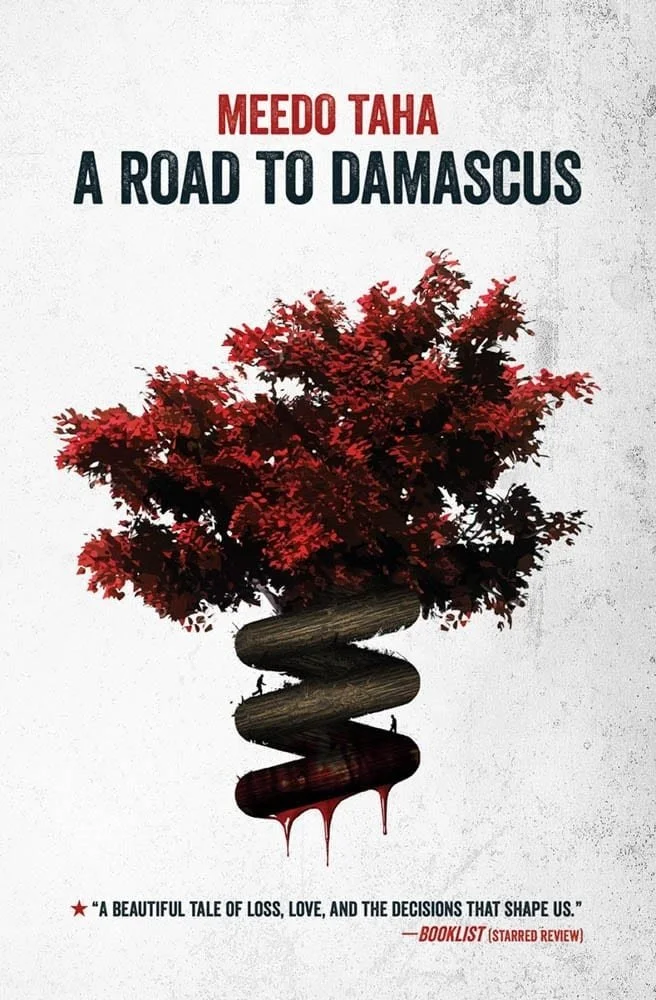
A Road to Damascus
an multigenerational murder mystery
writhed by Meedo Taha | published by Interlink
CHAPTER ONE - Incident
My eyes are only off the road for an instant. No, I lie: for two, maybe three seconds – that's all, three seconds! I toss a glance into the messenger bag on the seat next to me. It can't be more than that – a glance! And, yes, before looking down, I inspect the predawn road ahead: still murky, to be sure, but empty.
As I look back up – I promise not more than three seconds later – the nasty sound of metal on metal fractures the delicate silence and ricochets against the hillside. Like it has just hit ether, the Volvo doesn't even shudder as I bring it to a screeching stop. My forehead bashes into the steering wheel, my neck jolts back, and I catch a glimpse of what might be a passenger-less bicycle undulating to and fro. Where did the rider go? I have nary a second to conjure an apocalyptic theory before, out of the heavens, a pulpy mass lands onto my windshield with a crack, rolls off the hood, and disappears with a hideous thud.
Through a spider web now etched into the glass, I watch the bicycle's front wheel skid pathetically against the retaining wall and totter over. I must have forgotten to inhale during those few seconds – like a star-struck lover, they've left me breathless! – for a thundering exhale lifts me high above the scene as I watch myself yank up the handbrake and with the engine running, pop the door open. A dreadful chill knots in my chest, wrenching my suspended self back down into the joints of my legs, now stiff with fear.
But then the cyclist's head sprouts from behind the car hood with a smug smile, like it were all a minor inconvenience. "Wait, you're limping!" I yell through my reverie, but he regards me over his shoulder with a jovial "No I'm fine. It's how I walk."
So it's not a limp. It's how he walks. Terrific.
I find myself in front of the car now and vet over the young man as he grasps at the gravel, like he's lost a contact lens. The words "must" and "hospital" scuffle for my tongue, but by the time they settle into a coherent question, he has already found the bike leaning against the wall and planted his bony posterior onto its seat. His brown blazer exposes a tuft of blood-soaked cotton, muddied by the moist gravel. A nasty gash rips through his cheek. All in all, he looks anything but fine. Yet he brings the bicycle in line with the road, then yells, “See you later, Professor!” and pedals away. By the time I retort, "Wait! Do I know you?" his rickety silhouette has disappeared into the smog.
Back in the Volvo, the engine putters on, oblivious to the absurd incident it has perpetrated. My open messenger bag grins back at me, its zipper a string of teeth. No time to lose. Handbrake released, gear in first then second, the Volvo growls up the hillside.
#
Daylight kisses the Achrafieh skyline as I lock my car and make my way towards the site. Visible but inaudible, the highway traffic is sporadic with nocturnal travelers and early risers. Some cars have their headlights on, others off. The day is tentative, but will soon dawn here before anywhere else, along the main artery that connects Lebanon to Syria.
A droplet of water lands on my glasses as I raise the recorder to my lips and hit Record. "Of the sites I've studied so far, the Acacia tree is most populous on this particular patch of earth, but its thorns are browning." Punctuating my thoughts, a crackle of light tears through the sky. Then, thunder.
"Your last hope is this rain," I say as the first drops pitter-patter onto the Acacia, and I enjoy watching its needle leaves bounce back up after being hit with water. I must move fast. With scientific innovation at a plateau, botanists are so starved for new discoveries that they wouldn't stop at eating each other up to get one. Each new find must be snared from the jaws of the beast. It'll be dawn soon and if I'm spotted skulking here in the middle of nowhere it'll raise too many questions.
Running out of time, I don my plastic gloves and pull a spade out of my messenger bag. The moist soil gives way quite easily and in a few short moments it grazes the roots of the tree. I spread out a translucent plastic sheet inside the messenger bag, brush off the excess soil weighing down the roots, and place my sample inside. "Acacia collected," I say, barely able to think with the torrent pounding my scalp. "Hush now, we'll have you as good as new."
In the distance, along Damascus Road, a bus appears around the bend. I lift my metal frames against my forehead and run my hand over my face. My fingers slide under the glasses and press my eyes closed, but unease finds its way into my chest. From that distance, I must appear like a mote of dust in this naked field. The thought fills me with consummate emptiness as the thunder wraps itself around me.
#
I'm not sure if I close my eyes for an eternity or a few seconds. I pull my hands away and the glasses plop onto the ridge of my nose as my irises contract. During those seconds or that eternity, the sun has broken through the clouds, striking the wet highway with a merciless glare, filling me with dread.
The bus is much closer now. Its tires screech. Something isn't right.
From where I stand it looks like a visual echo, swerving in my direction then bouncing back and skidding farther away. It does another S-curve across the width of the highway then careens closer again. How could the vehicle have lost its balance so completely? It's not going fast; the road is wet, but at this speed it shouldn't matter; and even a punctured tire would still allow the driver enough control to stop. Reason eludes me as the bus crashes into a billboard on the roadside and comes to a lopsided stop. A lull, then steam puffs out of its belly, engulfing it in a milky haze.
Less than a dozen meters away, an ache gnaws into my side, perhaps what one might call "scientific curiosity." I throw the spade into my bag and sling it on my shoulder. With my recorder safely in my jacket pocket, I do a quick idiot-check behind me, then pace towards the highway. It looks more distant than it really is, a mirage of smoke and metal. First a skip, then a trot, then a run, and now a dash. My soles thicken with mud and my gait grows heavier, thunderclaps mocking my every stride.
Sunlight bursts through the clouds, the only trace of the stillborn daybreak. This must be the first bus of the morning, barely ten minutes into its journey from Beirut to Damascus. I'm close enough to discern its outlines through the thickening shroud of steam. It rests on three wheels, having sunk into a ditch on the side of the street. The billboard above it reads "Beirut Night. LIFE!" as if urging drivers to make a U-Turn back into the city and have a party.
Still on the driver side of the bus, I kneel by the front tire – years of training to look down. No puncture, just skid marks. Pulling off my hood, I straighten myself and scan the line of windows, now almost eye-level as the bus settles further into the ditch. There must be people on board already: the driver of course, and by this time five or six passengers. But more steam has leaked into the cabin and now it's hard to see inside. As I lean in for a closer look, a palm thwacks flat on the inside of the glass. It slides down then disappears, leaving behind streaks of red.
I circle around the back of the bus onto the road. The only way in is from the front right, where the wheel is almost half a meter off the ground. I rest my bag under it, take a deep breath and climb on.
My eyes take a few seconds to adjust to the dim interior. But even then, it's hard to see with all the steam. I waft at it and lift my hood back on, then cup my palm over my mouth and step forward. A faint moan fills the space like a trapped animal, and the driver lies slumped over his steering wheel with an eerie finality. Drenched in blood. He is – I struggle to find the right word – dead.
I trudge forward, as puddled rainwater splashes against my ankles and the steam thickens around me. I slice my palm through the opaque air, but it makes no difference. Then a second body materializes into view: a woman around thirty, knees hitched up, her pelvis contorted in a grotesque fetal position along a seat soaked with blood. The steam takes some of the edge off the sight, but my throat fills with a dull, ferrous taste.
The liquid at my feet is too heavy to be rainwater. It’s glutinous pools of red, lots of it, all over the floor. The moan rises towards me and I squeeze my way deeper into the bus, tripping over another body, its chest wide open. Then something squishes and cracks under my foot: the hand of a young man at the foot of another seat. Dead. The iron taste spreads through my mouth, bitter and bile-like. That’s three bodies now, all barely silhouettes. But the moan from the back belongs to someone alive. I make my way towards it, past more dead: four, then five.
I get to the rear of the bus and find a hefty man, thick mustache, dark suit, healthy until just a few minutes ago. An elegant black briefcase dangles from his lifeless fingers. The voice isn’t his. Then I turn to his right and find the moaner, bloody and trembling.
“Where is she?” he says and scratches at the window. I slide my arm under his and pull him up; he weighs close to nothing, limp as a withered leaf. Careful not to trip again, I wrap him around my back, drag him to the front of the bus, and step off. As I sit him down on the ground his head comes to a rest against the elevated front wheel. I wipe the grime off his cheek, then cup a handful of rain and wash his face.
Then I realize it’s the young man. He of the bicycle and the silly walk.
“Look at me!” I yell over the thunder and into his stupor, shaking him by his shirt, translucent with rain and caked with a mixture of dry blood, sweat, and mud. My knuckles scrape against his torn flesh, but his face shows no pain. What seems like an eternity earlier, my Volvo had spared his life. But now death has caught up with him, playfully teasing his eyes.
If he recognizes me, it doesn’t register through his delirium. “Where is she?” he says, barely a murmur.
“Forget her,” I say, smoothing his hair. “It’s only you and me.”
“The cat.”
“Your cat’s fine. I’ll take care of you. You’ll be fine too,” I lie.
“Feed the cat.” He exhales, then silence.
<<<<>>>>